
Key Takeaways
The Reality: The Adobe Sign China block is a permanent policy enforcement, not a temporary glitch.
The Risk: Network workarounds corrupt your audit trail. Hiding your location endangers the legal validity of your contracts.
The Pivot: Nota Sign delivers total APAC compliance.Featuring native integrations with iAM Smart and Singpass, it secures legally binding workflows across Mainland China, Hong Kong, and Singapore.
Introduction
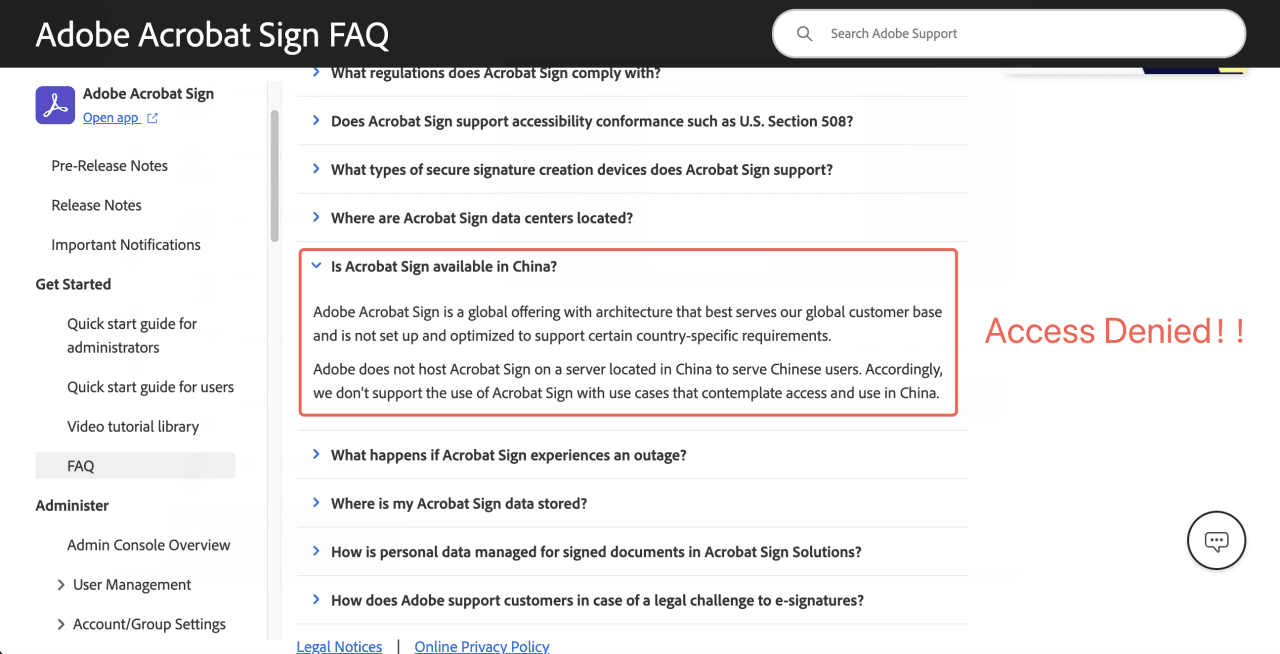
For many legacy Adobe users operating across borders, that persistent "loading" spinner is no longer just a random network glitch—it is the definitive Adobe Sign China block.
In fact, Adobe's own official documentation explicitly states that the service is not supported for use within mainland China. We are witnessing a hard segregation of services, where global tools are effectively geofencing the Mainland to sidestep complex data laws.

This reality forces a difficult pivot. Cross-border teams can no longer depend on software that treats China as an outlier. You need a bridge, not a barrier—a solution engineered to navigate the regulatory gap and keep your workflow moving without the legal risk of a VPN.
Inside the Adobe Sign Technical Blockade
To understand why the service won't load, we need to look at what is happening behind the scenes. This is not a random internet error; it is a permanent decision by Adobe.
- The Tech: This is a deliberate "kill switch." Adobe has effectively blocked all internet traffic coming from Mainland China. Unlike a firewall issue where the connection is just slow, this is a hard rejection. The system detects your location immediately and blocks the connection before the login page even appears.
- The Reason: The core issue is China’s Personal Information Protection Law (PIPL). This law strictly limits how personal data can be sent outside the country. Since Adobe stores its data in the US or Europe, serving users in China without local servers would break the law.
- The Impact: The problem isn't just about logging in; it is about where your files are stored. Even if you could force the app to open, saving a contract with Chinese data to a US server is now an illegal data transfer. Adobe instituted this block to eliminate that legal risk entirely.
The Risks of Using Network Workarounds
When the technical blockade began, many IT teams tried a quick fix: routing their internet traffic through a proxy server or "accelerator" to get around the wall. While this might technically open the login page, it creates two serious problems for your business.
- The Latency Trap:Even if you manage to route your connection through Hong Kong, the speed is rarely stable. Electronic signature platforms are "heavy"—they need to load large PDF files and verify security keys instantly. Pushing this data through a long, indirect network path causes timeouts. As a result,A simple contract takes forever to load.
- The Legal Void:This is the hidden cost of trying to fix issues with Adobe Sign in China via a "backdoor." The legal power of a digital signature relies on the Audit Trail. This is a log that proves who signed the document, when they signed it, and where they were. If your team in Shanghai signs a contract, but your network tool makes it look like they are in New York, you have corrupted the data. In a legal dispute, a judge could reject the contract because the digital evidence violates the physical reality.
The Hong Kong Bridge: Finding a Cross-Border Solution
- The Challenge: The difficulty lies in finding a tool that speaks two languages—not just English and Chinese, but "Global Standard" and "Local Compliance." Most Western tools work perfectly in Hong Kong but hit a wall north of the Shenzhen River. Conversely, domestic Mainland tools often lack the global-tier interface that Hong Kong international teams demand.
- The Criteria: Dual-Compliance:A viable solution must serve two legal masters simultaneously. It needs to satisfy Hong Kong’s Electronic Transactions Ordinance (ETO) to ensure validity for international commerce, while rigidly adhering to the Mainland’s Electronic Signature Law and PIPL regulations. If a platform only ticks one box, it exposes half your business to risk. Explore our compliance with PIPL and ETO standards in the Trust Center. No "Loading" Spinners:This is the simplest test of all. If you need a VPN to sign a document, the tool has failed. A Director in Hong Kong should be able to send a file, and a Manager in Shanghai should be able to sign it instantly. No lag, no loading spinners, and no special network settings—it just has to open.
Enter Nota Sign: The Compliant Alternative
Nota Sign is not merely a backup plan; it is a platform engineered specifically for the fractured digital landscape of the APAC.
- Localized Infrastructure: The platform wins because it stops fighting the Great Firewall. Unlike Western legacy tools that attempt to tunnel traffic from distant US servers, Nota Sign utilizes localized infrastructure that ensures a direct, low-latency connection on both sides of the border. There are no routing tricks or "accelerators" required—just a stable, compliant link between Hong Kong and the Mainland.
- Identity Verification: Compliance is baked into the authentication process. While it supports standard email verification for speed, it distinguishes itself with native integrations for high-security transactions. By connecting directly with Singpass and Hong Kong’s iAM Smart, it offers a level of identity assurance that generic US platforms simply cannot match in this region.
- Seamless Transition:Perhaps the strongest advantage is familiarity. Because the interface mirrors the global design standards set by Adobe and DocuSign, your team can switch platforms without needing a new manual. This solves the technical blockade without disrupting your daily business. You get the best of both worlds: a user experience your team already knows, powered by a local engine that complies with regional laws.
Conclusion: Secure Your Workflow
The writing is on the wall. The issues with Adobe Sign in China are not a temporary bug; they are the new reality. Clinging to legacy tools that require unstable "workarounds" is a gamble. You are risking your data's legal standing and your team's patience. Don't wait for the "Service Unavailable" screen to cost you a deal. It is time to align your tools with the region you operate in. Ensure your next contract is signed, not blocked. Switch to Nota Sign. Get in touch with the Nota Sign sales team right away.
FAQ
1.Q: Is Adobe Sign temporarily down in China, or is this permanent? A: This is a permanent restriction, not a temporary outage. Adobe’s official documentation states that the service is unavailable in Mainland China. The block is driven by compliance with China’s Personal Information Protection Law (PIPL), which restricts the storage of Chinese citizens' data on offshore servers.
2.Q: Why can’t we just use a VPN to bypass the block? A: While a VPN might technically allow you to log in, it compromises the legal validity of your documents. A digital signature’s power relies on its Audit Trail—proof of who signed and where. Using a VPN masks the signer’s true location, which "corrupts" this data and can lead to the contract being challenged or rejected in court.
3.Q: Is Nota Sign legally binding for cross-border contracts between Hong Kong and the Mainland? A: Yes. Nota Sign is designed for dual-market compliance. It satisfies Hong Kong’s Electronic Transactions Ordinance (ETO) for international validity and rigidly adheres to the Mainland’s Electronic Signature Law and PIPL regulations. This ensures your contracts are enforceable on both sides of the border.