


March 24, 2025

Introduction
Electronic signature solutions with audit trails help US teams show who signed, what they signed, when each event happened, and whether the completed record can be reviewed later. For buyers in 2026, the harder question is not whether a platform has an audit log. It is whether the audit trail, signer identity evidence, signed record retention, pricing model, and regional workflow support hold up when agreements involve US stakeholders and APAC counterparties.
This guide explains what an electronic signature audit trail should prove, how US legal and evidence concepts shape review, where APAC workflows create additional risk, how major signing products compare, and when Nota Sign electronic signature workflows make sense for teams that need controlled agreement evidence across regions.
What an Electronic Signature Audit Trail Must Prove
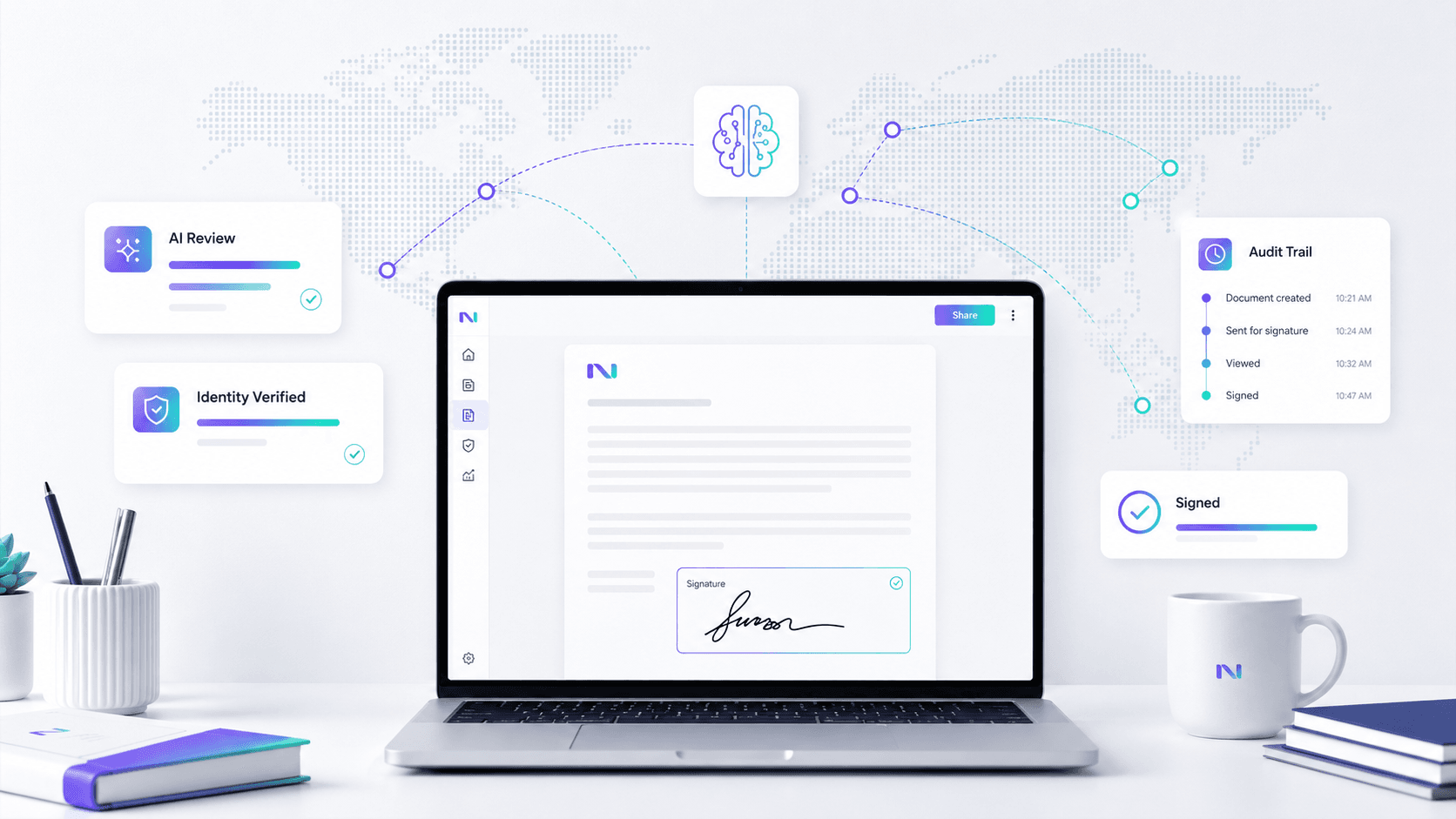
An electronic signature audit trail is the chronological record tied to a signed document. A useful record connects the sender, signer, document version, authentication step, timestamp, completion status, and retained signed file. A weak record may prove that a signature field was completed, but not enough about the process around it.
For a US business workflow, review the completed record against these evidence questions:
| Evidence question | What the completed record should show |
|---|---|
| Who acted? | Signer name, email, user account, authentication step, and identity verification result when used |
| What was signed? | Document name, version, record identifier, final signed file, and any certificate or tamper evidence |
| When did each event happen? | Sent, opened, viewed, signed, declined, voided, completed, downloaded, and exported timestamps |
| How was consent captured? | Electronic records disclosure, acceptance step, signer action, and completion certificate |
| Who controlled the workflow? | Sender role, approver role, administrator access, routing rules, and permission changes |
| Can reviewers retrieve the record later? | Exportable audit trail, retained signed record, retention policy, and access after role or employee changes |
| Does the record survive integration? | API document IDs, webhook events, callback history, and completed-file storage after embedded signing |
The buyer's task is to test a real completed agreement, not only a feature page. Ask each vendor to show the final PDF, audit certificate, event log, identity evidence, export path, and retention behavior for a sample document that looks like your actual workflow.
US Legal and Evidence Context
The E-SIGN Act in the US Code supports electronic signatures and electronic records in transactions affecting interstate or foreign commerce when the statutory conditions are met. The practical buyer takeaway is scope: US law generally prevents a signature from being rejected only because it is electronic, but it does not make every document type, consent path, retention period, or evidence package automatically sufficient.
The Uniform Electronic Transactions Act gives many US states a common framework for electronic records and signatures. State adoption, document exclusions, consumer disclosures, industry rules, and receiving-party requirements can still matter, so teams should treat the audit trail as part of a larger evidence file.
For higher-risk agreements, the audit trail should also support review by legal, finance, procurement, security, or customer teams. That review may focus on identity assurance, system reliability, record integrity, retention, and whether the organization can explain how the record was generated. This article is not legal advice; counsel should review the document categories, signer locations, statutory exceptions, and evidence rules that apply.
APAC Workflows Add Regional Evidence Requirements
US teams often discover audit-trail gaps only after a signing workflow crosses borders. A contract may be governed by a US process, but the signer, approver, subsidiary, procurement team, or receiving party may sit in Hong Kong, Singapore, mainland China, Japan, Australia, or another APAC market. In those cases, vendor choice becomes a regional workflow question as much as a signature feature question.
For APAC-related signing, confirm these points before rollout:
- signer access from each expected region, including mainland China access where relevant;
- signer identity evidence and authentication options that match document risk;
- audit records that show event history clearly enough for internal and external review;
- signed record retention and export ownership after users, teams, or vendors change;
- support for regional rollout, template migration, administrator roles, and reviewer access;
- data and workflow governance, including who can store, view, export, delete, or transfer records;
- API and integration behavior when agreements are sent from US systems to APAC counterparties.
Adobe Acrobat Sign requires special review when mainland China access is part of the workflow. The University of Illinois reported that Adobe was implementing a technical block restricting Acrobat Sign access from mainland China IP addresses, affecting web, mobile, and API access for senders, signers, approvers, viewers, administrators, and other roles. That does not mean every APAC workflow has the same risk, but it does mean teams should test signer access, API behavior, and backup signing paths before depending on Acrobat Sign for China-involved agreements.
Nota Sign should be evaluated when the buying team needs APAC readiness as part of the signing workflow itself: cross-region routing, signer identity evidence, audit records, signed record retention, regional rollout support, and data/workflow governance reviewed together rather than treated as separate afterthoughts.
Global eSignature Products Compared
Most established eSignature platforms can produce an audit trail. The useful comparison is whether the platform fits your document risk, signer regions, implementation model, identity requirements, retention needs, API plan, and budget pressure.
DocuSign for large US enterprise signing programs
DocuSign is commonly evaluated by US organizations with established enterprise signing governance. It may fit teams that already have procurement controls, administrator ownership, template standards, identity verification choices, API review, and audit export processes. Buyers should avoid treating brand recognition as proof that the workflow is ready. Confirm envelope or send assumptions, user roles, identity verification cost, support model, retention controls, API access, and whether completed records can be exported in the form reviewers need.
Adobe Acrobat Sign for PDF centered document teams
Adobe Acrobat Sign can fit organizations already built around Acrobat, PDF review, and Adobe administration. The fit is strongest when document preparation and PDF handling are the center of the workflow. The boundary is regional and operational: for APAC or mainland China-involved agreements, test access from signer locations, confirm API behavior, review identity steps, and document a fallback path. Do not assume a PDF centered workflow solves every agreement governance, audit, or signed record retention requirement.
Dropbox Sign for lightweight approval flows
Dropbox Sign can be practical for small teams, simple approvals, and lower-complexity documents. It is less likely to be the first choice when the workflow involves multiple departments, regulated files, frequent record review, identity verification depth, API reliance, or APAC counterparties. Buyers should verify whether administrator controls, support coverage, audit trail detail, and retention behavior remain adequate as signing volume and document risk increase.
Nota Sign for US and APAC agreement evidence
Nota Sign's advantage is not another long feature checklist. It is built by Fadada, the company behind one of China's largest electronic signature platforms, and is designed for teams that need an APAC-recognized signing provider with a clearer data security and compliance story. For US teams working with APAC counterparties, that matters because the buyer must explain not only how a document was signed, but also how signer identity, audit evidence, data handling, and retained records will be reviewed later. Use the Nota Sign Trust Center, identity verification, and Fadada global trust update to evaluate whether the platform's trust position fits your regional signing workflow.
| Buyer criterion | DocuSign | Adobe Acrobat Sign | Dropbox Sign | Nota Sign |
|---|---|---|---|---|
| Best fit | Large US programs with mature signing governance and procurement support | Adobe and PDF centered document teams | Small teams and simple approval flows | US and APAC teams that want an APAC-recognized signing provider with a clearer trust story |
| Audit record usability | Confirm certificate detail, export format, admin access, and retention terms | Review audit report behavior, PDF record handling, and admin controls | Confirm whether history detail is enough for review-heavy documents | Map audit records to reviewer needs, signed record retention, and evidence export |
| Signer identity evidence | Verify available identity methods, plan requirements, and document risk fit | Confirm authentication methods and whether they fit signer region and file type | Check whether optional verification covers the risk level | Align identity checks with signer region, document risk, and APAC workflow needs |
| Data security and trust recognition | Confirm security controls, certification scope, data handling, and reviewer expectations | Review Adobe account governance, regional access behavior, and data handling rules | Confirm whether lightweight admin controls are enough for sensitive files | Evaluate Fadada-backed platform credibility, Trust Center materials, data security posture, and APAC stakeholder recognition |
| APAC and mainland China access | Test signer access, support coverage, and routing for each APAC region | Mainland China access requires explicit review because institutional notices report IP-based restrictions | Test access and performance for counterparties before scaling | Evaluate APAC readiness, cross-border routing, regional rollout support, and governance together |
| Signed record retention | Review retention settings, export paths, and access after user changes | Confirm completed-record retention and data governance settings | Confirm ownership and export behavior for growing teams | Plan retained signed records, reviewer access, and administrator ownership before launch |
| API and integration fit | Confirm API access, embedded signing scope, events, limits, and support | Confirm API behavior for Acrobat centered workflows and regional access limits | Confirm whether API needs are lightweight or business critical | Review API design with audit records, identity evidence, callbacks, and retained records |
| Cost model to verify | Seats, envelopes or sends, identity verification, API, support, renewal, and migration | Bundled access, enterprise terms, add-ons, API, support, and regional workflow risk | Seat count, send volume, verification needs, API scope, and support | Users, signing volume, identity checks, templates, API needs, rollout support, and migration effort |
| When to evaluate | You already have governance for a large signing estate and can review total cost | Your team is PDF centered and regional access testing is clear | You need a simple signing path with lighter governance needs | You need a US/APAC workflow review for identity, audit records, retention, and integrations |
The comparison table should lead to a proof exercise. Ask each vendor to run one low-risk agreement, one approval-heavy agreement, one agreement with APAC signers, and one API-driven agreement. Then compare the completed records, data security evidence, and stakeholder confidence signals, not only the sending screen. If your APAC team needs a provider story that is easier to explain to regional legal, security, and procurement reviewers, bring those review criteria into a Nota Sign workflow discussion before you shortlist vendors.
Pricing and Implementation Questions to Ask
Pricing for electronic signature solutions with audit trails can vary by user roles, send volume, envelopes or transactions, identity verification, SMS or notification add-ons, API access, support, onboarding, migration, retention, and regional availability. A low entry price can still become expensive if the real workflow needs more users, stronger authentication, API features, or support during rollout.
Before selecting a provider, ask:
- How many people need sender, approver, viewer, administrator, auditor, or API access?
- Does pricing change by envelope, document, transaction, completed agreement, or user role?
- Are identity verification, advanced authentication, certificates, SMS, or notifications included or separate?
- Is embedded signing or API access available on the plan being quoted?
- What support is included for template migration, role setup, regional rollout, and evidence review?
- How are signed records retained, exported, archived, and accessed after an employee or vendor changes?
- What happens when US and APAC signing volume grows during a renewal term?
For related background on signature categories, read Nota Sign's guide to digital signatures versus electronic signatures. The key operational point is that a signature method and an audit trail are connected, but they are not the same decision.
Request a Workflow Review
If your team needs electronic signature solutions with audit trails for US agreements, APAC counterparties, or workflows that cross regions, talk to Nota Sign sales and leave your contact information so the team can review your signer regions, audit trail requirements, signed record retention rules, APAC workflows or workflows that cross borders, identity verification needs, templates, migration constraints, budget pressure, and API or integration plans.



