


February 11, 2026

Introduction
Signing contracts online is easy. Proving they are valid in court is hard.
In the rush for efficiency, many businesses rely on simple "click-to-sign" tools. While these are sufficient for low-risk internal approvals, they often crumble under legal scrutiny. If a dispute arises years later, proving who actually clicked that button can be nearly impossible.
This is where the Qualified Electronic Signature (QES) separates itself from the rest of the market.
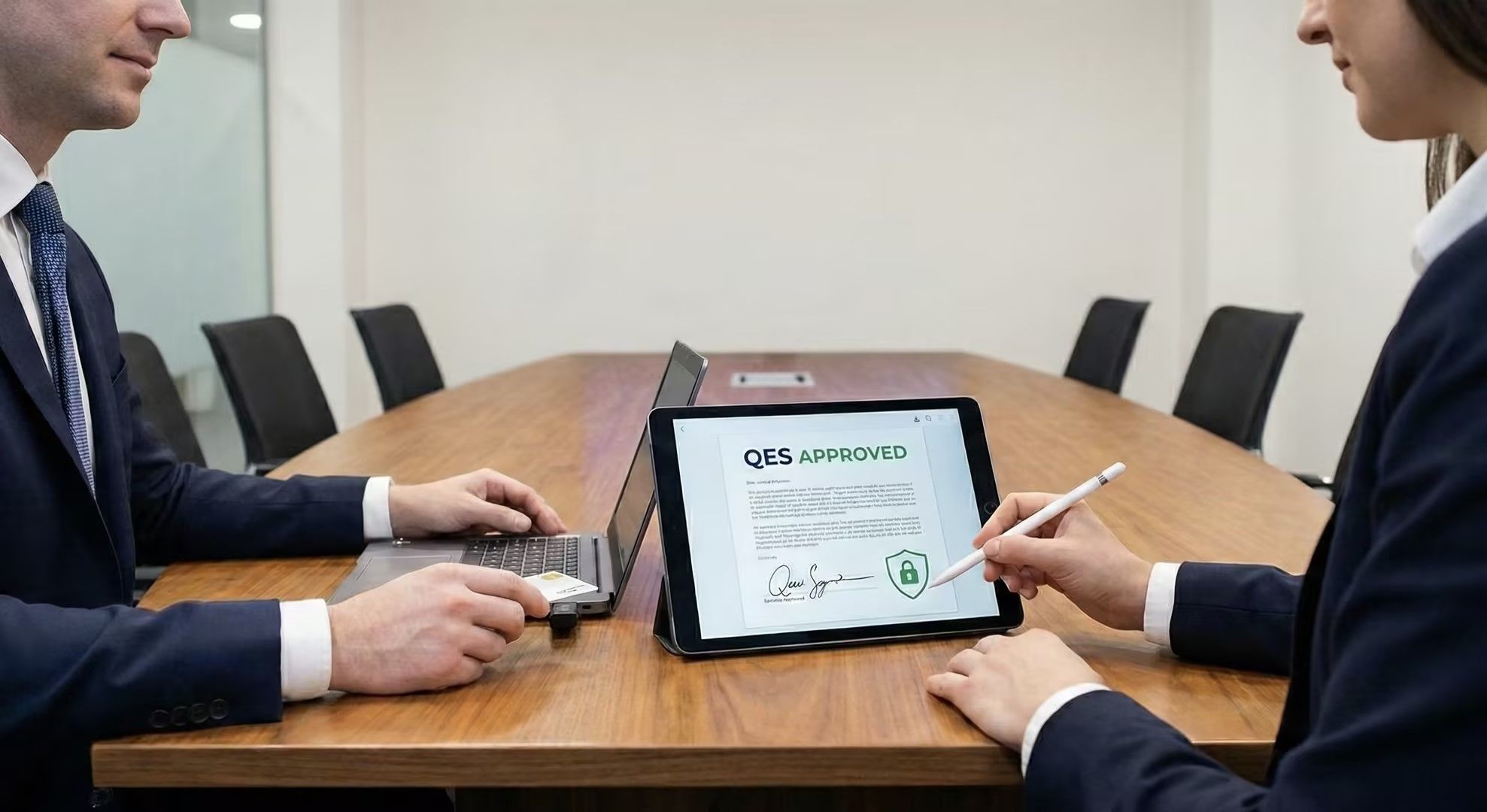
A QES is the most secure type of digital signature available today. Defined under the EU’s eIDAS regulation, it is the only electronic signature that is legally identical to a handwritten "wet ink" signature. It is not just a digital mark; it is a binding legal assertion backed by a government-vetted Trust Service Provider.
The distinction is critical. If you are handling high-value commercial agreements, cross-border transactions, or strict government tenders, a standard signature leaves you vulnerable.
A QES, however, provides a legal presumption of validity. If you cannot afford for a contract to be voided, you likely need a QES.
The 3 Characteristics of a QES
A Qualified Electronic Signature is defined by three non-negotiable standards that separate it from a standard "click-to-sign" agreement.
Strict Identity Check (The "Digital Passport") Unlike basic signatures, you cannot simply use an email address to validate a QES. You must verify your identity through a Qualified Trust Service Provider (QTSP). This typically requires scanning a valid government ID (passport or national ID card) and passing a video verification check (Face ID or a live video call) to prove you are a real person.
Tamper-Proof Integrity A QES acts as a digital seal. The moment the signature is applied, the document is cryptographically locked. If anyone changes even a single comma or a price digit after signing, the signature immediately becomes invalid. There is no guesswork: the document is either 100% original, or it is broken.
Legal Power (The Reversed Burden of Proof) This is the most critical commercial advantage. If a standard e-signature is challenged in court, you must prove it is genuine. With a QES, the burden of proof is reversed. The court automatically presumes the signature is valid. The person attacking the signature is the one who has to prove it is fake.
QES vs. AES vs. SES: The Hierarchy of Trust
Under EU eIDAS regulations, digital signatures are ranked by security. Think of them as Bronze, Silver, and Gold standards.
Simple Electronic Signature (SES) – The "Bronze" Standard The "Wild West" of signing. A simple "I Agree" button or a pasted image of a signature. Fast but legally weak. Anyone could have clicked it.
Advanced Electronic Signature (AES) – The "Silver" Standard The business standard. It uses 2-factor authentication (email + SMS) to link the signature to a specific person and detects if the document changes. Secure enough for 90% of B2B agreements (Sales, NDAs).
Qualified Electronic Signature (QES) – The "Gold" Standard The regulatory apex. It requires strict ID verification (Passport + Video). It is the only type legally identical to a handwritten "wet ink" signature. Mandatory for high-stakes litigation, HR firing, and government forms.
When Should You Use a QES? (Use Cases)
You do not need a QES for everything. Using a "Gold Standard" signature for a low-risk internal form is overkill. However, for specific high-stakes scenarios, using anything less is a gamble.
Here is why managers in four key sectors insist on it:
1. Human Resources (The "Void Contract" Risk) In countries like Germany, strict labor laws (e.g., § 126 BGB) require "wet ink" or QES for key documents.
- The Risk: If you sign a fixed-term contract with a standard e-signature, it is legally void. This can accidentally convert a temporary hire into a permanent employee by default.
2. Life Sciences & Pharma (The Audit Trail) Agencies like the EMA and FDA demand rigorous data integrity for clinical trials.
- The Risk: Failed audits. A standard signature can't always prove a document wasn't altered post-signing. A QES provides a cryptographic seal that guarantees the data is original, satisfying the strictest compliance officers.
3. Banking & Finance (Remote KYC) Banks must adhere to strict "Know Your Customer" (KYC) and Anti-Money Laundering (AML) laws.
- The Risk: Customer drop-off. Forcing clients to visit a branch to show ID kills conversion rates. QES allows for fully digital, legally compliant onboarding by verifying identity remotely via video.
4. Cross-Border Deals (Legal Certainty) Legal standards vary wildly across borders. A signature valid in London might be questioned in Madrid.
- The Risk: Unenforceable contracts. QES is the "universal adapter" of signatures. It is automatically recognized across all EU member states and widely respected globally, removing the "format risk" from international trade.
How to Get a QES (And is it Free?)
You do not need to be an IT expert to use a Qualified Electronic Signature. The complex cryptography happens in the background. As a user, you generally just need a smartphone and a valid ID (Passport or National ID Card).
The 4-Step Process:
- Receive the Link: You get an email invitation to sign a document.
- Scan ID: Use your phone camera to take a photo of your ID document.
- Verify Liveness: Complete a quick video check (e.g., turn your head, read a number) or connect briefly with a live agent. This proves you are a real person and not a deepfake.
- Sign: Once verified, you enter a PIN or draw your signature. The digital certificate is issued instantly, and the document is sealed.
Is it Free? The short answer is: Real security costs money.
Because a QES requires a strict third-party verification of your government ID (which incurs a fee from the provider), it is rarely "free" forever.
- For Signers: It is usually free. The company sending the document pays the bill.
- For Senders: You typically need a paid subscription to cover the verification costs.
However, you can try it before you buy. At Notasign, we believe you should experience the workflow first. We offer a 14-day free trial where you can send documents and test the QES process without spending a cent.
👉 Ready to start? Learn more about setting up your first QES in our Support Center.
Why Choose Notasign for Your Global Business?
The Friction Problem Historically, "high security" meant "bad user experience." Implementing QES used to require physical USB tokens, card readers, or rigid local vendor lock-in.
The Notasign Solution:
- Bridging EU and APAC: Most QES providers focus solely on domestic European markets. Notasign specializes in cross-border connectivity, particularly between Europe and the Asia-Pacific region. Whether your counterparty is in Berlin, Singapore, or Shanghai, we ensure the signature process is seamless and legally recognized.
- Flexible Workflows: We don't force you into a "one-size-fits-all" process. Mix standard signatures for NDAs and QES for final contracts in a single, smooth workflow.
Need to bridge the gap between global teams? Contact us today to discuss your specific cross-border needs.
FAQ
1. Is QES mandatory for all contracts? No. For 90% of daily business (NDAs, POs), a simple or advanced signature is fine. QES is for high-risk or regulated documents.
2. What is the difference between digital signature and electronic signature? "Electronic signature" is the legal term for the action (signing). "Digital signature" is the technology (encryption) behind it. QES combines both.
3. Can I use QES outside of Europe? Yes. While it is an EU standard, it is highly respected globally and meets the security requirements for the US ESIGN Act.

