


August 25, 2026

Introduction
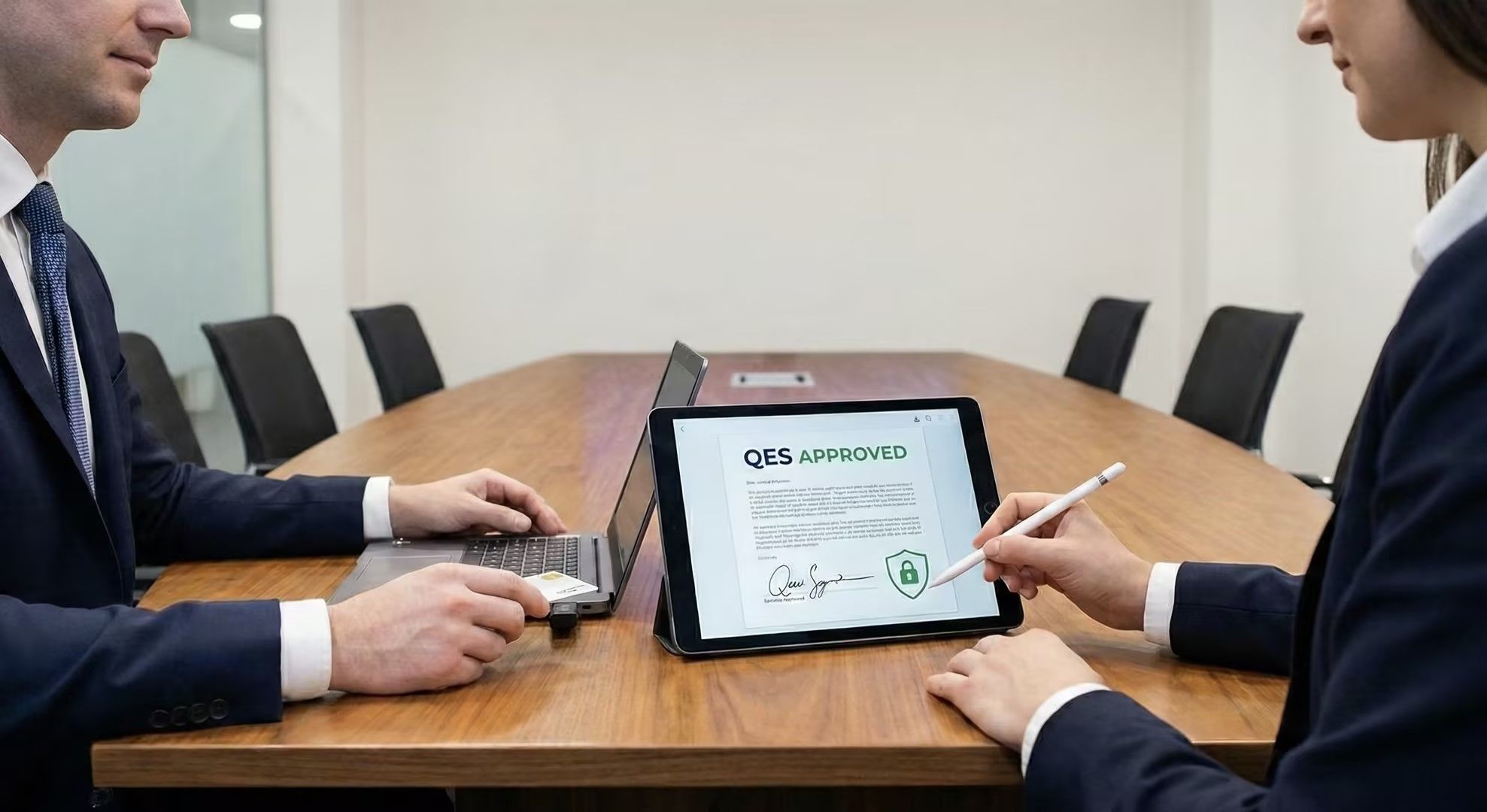
A qualified electronic signature, or QES, is the highest assurance electronic signature category under the EU eIDAS framework. It combines an advanced electronic signature with a qualified certificate, a qualified trust service provider route, and a qualified signature creation method. Under eIDAS, a valid QES can carry legal effect equivalent to a handwritten signature.
That does not mean every agreement needs QES, or that QES automatically solves every legal, commercial, or jurisdictional question. The practical decision is more specific: what law applies, what the recipient requires, what identity evidence is needed, and whether the document type justifies the extra assurance.
This guide explains what QES means, how it differs from SES and AES, when businesses should consider it, and how teams operating across APAC, Europe, and the United States can choose a signing level without overbuying or under-proving the transaction.
What a Qualified Electronic Signature means under eIDAS
The EU eIDAS framework defines three levels of electronic signature: simple electronic signature, advanced electronic signature, and qualified electronic signature. The European Commission's eSignature guidance treats QES as the qualified level, built on top of the requirements for an advanced electronic signature.
The legal importance of QES comes from Article 25 of the eIDAS Regulation. Article 25 establishes that an electronic signature cannot be rejected only because it is electronic, and it gives a qualified electronic signature equivalent legal effect to a handwritten signature within the eIDAS framework.
For business teams, the key point is scope. QES is a specific eIDAS assurance level. It is not the same as saying every electronically signed document is automatically valid everywhere, or that every cross-border contract requires QES. Some documents may still require paper signing, notarization, public filing, a specific portal, or local legal review. QES strengthens signer identity and document integrity evidence, but the surrounding transaction still matters.
What makes a signature qualified
A QES is not just a visual signature image on a PDF. It depends on a chain of identity, certificate, provider, and creation-method controls. Buyers should check all of the elements below before treating a workflow as QES.
Qualified certificate
A QES must be based on a qualified certificate for electronic signatures. The certificate connects the signer to cryptographic signing credentials after identity proofing. In practice, the certificate is what allows a relying party to inspect who signed, which certificate was used, and whether the signed document was changed after signing.
The buyer check is simple: do not accept the word "certificate" as enough. Confirm whether the certificate is qualified for electronic signatures, who issued it, what identity proofing route was used, and whether the relying party can validate the certificate chain.
Qualified trust service provider
A qualified certificate is issued through a qualified trust service provider, often shortened to QTSP. EU member states maintain trusted lists of qualified providers and services, and the European Commission provides an EU trusted lists overview and the EU/EEA Trusted List Browser for verification.
This is where many procurement mistakes happen. A signing platform may support digital signatures, certificate-backed signing, identity checks, or regional trust routes, but that alone does not prove the platform itself is a QTSP or that every signing flow produces QES. For QES use cases, verify the specific provider, service status, certificate type, and relying-party acceptance.
Qualified signature creation device
QES also depends on a qualified signature creation device, or QSCD. A QSCD is the controlled environment used to create the qualified signature. Depending on the provider and market, this may involve a physical device, a smart card, a secure token, or a qualified remote signing setup.
Teams should ask how the signing key is protected, whether the signing action remains under the signer's control, and what evidence is retained to show that the qualified signing method was used. A polished signing screen is not enough; the technical trust route behind it is what matters.
Strong signer identity proofing
QES requires strong identity proofing before the qualified certificate or signing route can be used. The exact method varies by trust service provider, country, and document scenario. It may involve national eID, remote identity verification, identity document checks, bank identity, video verification, in-person verification, or another approved route.
The operational question is not "was there an ID check?" It is whether the identity proofing route satisfies the required assurance level for the certificate and the transaction. For higher-risk agreements, retain enough evidence for a legal, compliance, or counterparty review later.
How QES, AES, and SES compare
SES, AES, and QES are often discussed as if they are three product tiers. They are better understood as evidence levels. The right choice depends on the document, recipient, law, identity risk, and dispute risk.
| Criteria | SES | AES | QES |
|---|---|---|---|
| Best for | Low-risk approvals, internal acknowledgements, routine forms, and simple commercial documents where the recipient accepts basic evidence. | Standard B2B contracts, controlled approvals, and documents that need stronger signer identity and tamper evidence but do not specifically require QES. | High-assurance EU or eIDAS-specific workflows, public-sector or regulated transactions, and documents where the recipient requires qualified signing evidence. |
| Setup effort | Usually lowest; the main work is making sure consent, timestamp, signer action, and document version are captured. | Moderate; teams need stronger authentication, signer-control evidence, integrity checks, and audit records that reviewers can understand. | Highest; teams must verify the qualified certificate, QTSP route, QSCD, identity proofing route, recipient acceptance, and document-specific requirement. |
| Pricing / cost risk | Usually lowest, but weak evidence can become expensive if the document is later disputed. | Higher than SES when identity verification, certificates, API controls, or implementation support are required. | Usually the highest due to qualified certificate, trust-service, identity proofing, and operational review requirements. |
| Workflow limits | Not suitable when the key dispute risk is signer identity, certificate trust, or high-assurance legal effect. | Stronger than SES, but it still may not satisfy a recipient that specifically requires QES. | Strongest under eIDAS, but not a universal replacement for legal review, authority checks, filing rules, or non-EU requirements. |
| Identity verification | Often based on email access, account access, or basic signer action. | Uses stronger authentication or identity proofing, depending on the workflow. | Requires identity proofing that supports the qualified certificate and qualified signing route. |
| Audit trail | Should show who acted, when, from what access route, and which document version was signed. | Should add stronger signer evidence, integrity evidence, and a record that can support later review. | Should preserve qualified certificate and trust-chain evidence alongside the signed record and audit events. |
| Compliance fit | Fits lower-risk documents when electronic acceptance and evidence are sufficient. | Fits many business agreements that need stronger evidence without a qualified-signature mandate. | Fits transactions where eIDAS-qualified assurance or a recipient's QES requirement controls the signing route. |
| Support / onboarding | Usually straightforward if the organization has simple signing policies. | Requires legal, operations, and IT alignment on identity, audit, retention, and signer controls. | Requires the most careful rollout because trust-service status, certificate evidence, and recipient acceptance must be verified. |
| When to choose it | Choose SES when intent evidence and a clean audit trail are enough. | Choose AES when the business needs stronger identity and document-integrity evidence. | Choose QES when the transaction depends on qualified eIDAS evidence or a receiving party requires QES. |
This comparison matters because QES is not always the best default. If a routine approval only needs a clear audit trail, SES may be sufficient. If a commercial agreement needs stronger signer identity, tamper evidence, and audit records, AES may be the better fit. QES becomes important when the transaction needs the eIDAS qualified level or the counterparty explicitly requires it.
When businesses should use QES
Businesses should consider QES when the signing decision depends on the highest eIDAS assurance level, not merely because a document is important. Common examples include public-sector submissions, regulated transactions, high-value agreements involving EU counterparties, employment or finance documents where the recipient requires QES, and board or authority documents where identity disputes would be costly.
QES is also useful when a receiving party has already defined QES as the accepted route. In that case, the business question is not whether QES is "better" than AES. It is whether the signing workflow can produce the exact evidence the recipient will accept.
For multi-market companies, the practical policy is usually mixed. A team may use SES for low-risk approvals, AES for most business contracts that need stronger evidence, digital certificates or eSeals for document integrity and organizational authority, and QES for the specific scenarios where eIDAS-qualified evidence is required.
Teams operating across APAC, Europe, and the United States should avoid copying one region's signing rule into every market. Europe may require eIDAS-specific analysis. The United States has different electronic signature frameworks and evidence expectations. APAC markets may involve local electronic transaction laws, national digital ID routes, certificate authorities, or recipient-specific acceptance rules. A strong signing policy maps the document type first, then chooses the signing level.
What QES proves and where its limits are
QES can materially improve the evidentiary strength of a signing process, but it does not replace legal review or business controls. The distinction matters for procurement, compliance, and dispute preparation.
| QES can strengthen | QES does not automatically prove |
|---|---|
| The signer used a qualified certificate route tied to verified identity. | The signer had authority to bind the company. |
| The signed data can be checked for later changes. | The contract terms are lawful, fair, or enforceable in every jurisdiction. |
| The trust chain can be validated through qualified trust service information. | Every recipient, court, regulator, registry, or platform will accept the document without additional process. |
| The signing process may carry handwritten-equivalent legal effect under eIDAS when valid. | Non-EU legal frameworks will treat the signature in the same way. |
| The audit and certificate record can support later review. | A business no longer needs approval controls, role permissions, retention policy, or legal routing. |
This is why good QES implementation is not only a signing-button choice. It requires document classification, signer authority checks, identity proofing, certificate validation, audit records, signed record retention, and a clear escalation path when a document type may require legal review.
How teams should choose the right signing level
The safest way to choose a signing level is to start with the document and recipient, not the software feature list. Use the questions below before deciding whether SES, AES, QES, digital certificates, eSeals, or a paper signing route is appropriate.
| Decision question | Why it matters |
|---|---|
| Which law, counterparty rule, platform, regulator, or filing body controls acceptance? | A document may be electronically signable in general but still require a specific route. |
| What dispute would matter most: identity, intent, authority, document integrity, or timing? | Different evidence problems require different signing controls. |
| Does the signer need strong identity proofing before signing? | If identity risk is high, basic email access may not be enough. |
| Does the recipient require QES or a qualified certificate? | If yes, an AES or ordinary digital signature route may not satisfy the receiving party. |
| What must be retained after signing? | The signed file, audit trail, certificate evidence, authentication events, and access history may all matter later. |
As a working model, routine internal approvals often fit SES. Most controlled B2B agreements that need stronger identity and tamper evidence often fit AES or certificate-backed digital signatures. EU or eIDAS-specific high-assurance scenarios may require QES. Documents involving organizational authority may also require an eSeal, board approval record, signer role control, or a separate authority check.
Where Nota Sign fits in higher-assurance signing workflows
Nota Sign is a multi-market eSignature and agreement-workflow platform for teams operating across APAC, Europe, and the United States. Its role is to help teams manage the signing workflow around the evidence: signer identity checks, certificate-backed digital signatures, CA verification routes, eSeal workflows, audit records, and signed record retention.
For teams that need stronger signing evidence, Nota Sign's electronic signature platform supports structured agreement workflows and reviewer-ready records. For certificate-backed and higher-assurance signing scenarios, Nota Sign helps teams connect digital certificates, signer evidence, and document integrity controls into the signing process, with trust and security controls that support reviewer-ready governance.
For QES-specific use cases, the verification point remains precise: confirm the QTSP, qualified certificate, QSCD route, recipient acceptance, and document-specific legal requirement before treating the workflow as QES. Nota Sign can support the agreement workflow and evidence controls around that decision, while the qualified trust-service status itself should be verified through official trusted-list evidence.
If your team is classifying which agreements need SES, AES, certificate-backed digital signatures, eSeals, or QES, contact Nota Sign with the signer regions, document types, identity proofing needs, and retention requirements you need to support.
Final Recommendation
Use QES when the transaction depends on eIDAS-qualified identity, certificate, and signature-creation evidence, or when the recipient explicitly requires a qualified electronic signature. Do not use QES as a blanket label for every important agreement. For many business documents, AES or certificate-backed digital signatures may provide the right balance of signer identity, tamper evidence, audit records, and operational speed.
The best policy is tiered: classify document types, define the evidence needed for each tier, confirm regional and recipient acceptance, and retain the signed record in a way that legal, compliance, and operations teams can inspect later. Nota Sign can help teams design that tiered workflow across APAC, Europe, and the United States without reducing the decision to a single signature button.
For a signing-level review, talk to Nota Sign sales about your document categories, signer locations, identity requirements, certificate routes, and audit-record expectations before choosing a QES path.



