July 27, 2026

Introduction
Hong Kong businesses should not have to treat identity verification and contract signing as two unrelated jobs. Nota Sign has announced an integration with iAM Smart, Hong Kong’s digital identity platform, to bring a familiar local identity step into an online agreement journey.
The announcement matters most to teams that serve Hong Kong residents while coordinating contracts across the Greater Bay Area and wider APAC. A signer can encounter a locally recognised identity route at the point where a document needs to be signed, while the business keeps the agreement workflow in Nota Sign.
That is a practical improvement, not a blanket legal conclusion. The right signing route still depends on the document, parties, recipient requirements, and evidence a business needs to retain. The opportunity is to remove unnecessary repetition from a well-designed process—not to assume that one identity method answers every transaction question.
01. A Trusted Local Identity Entry Point for Digital Agreements
iAM Smart is Hong Kong’s one-stop digital service platform. Its public service overview lists authentication, form filling, personalised notifications, and digital signing among its functions; digital signing is available to eligible iAM Smart+ users. With Nota Sign’s announced integration, an eligible user can move from that familiar identity interaction into a document-signing journey without being asked to create a disconnected account or re-enter the same information.
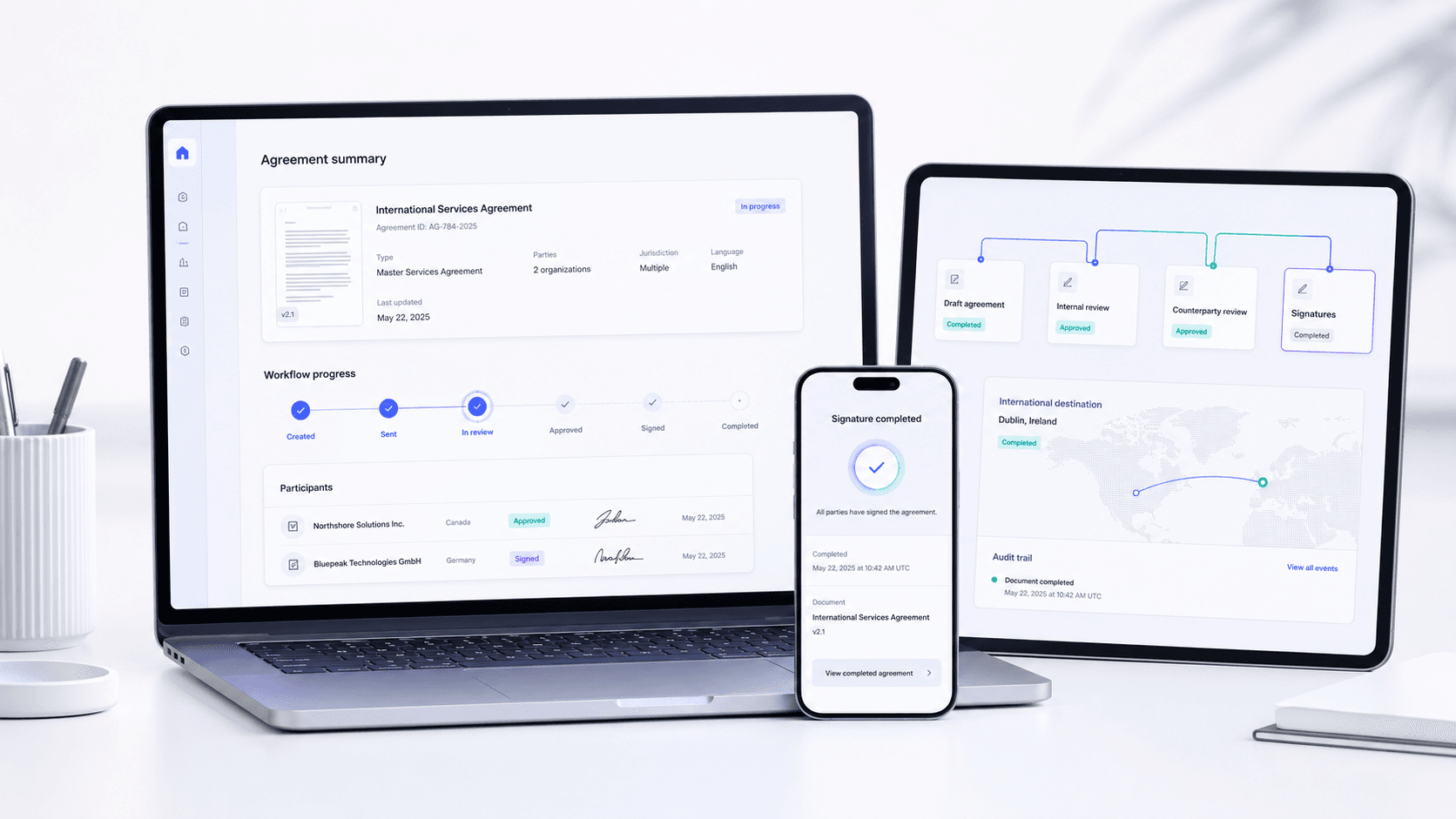
For an operations team, this changes the starting point of an agreement workflow. Instead of treating identity as a manual checkpoint before the contract is sent, the team can design the invitation, identity step, document task, reminder, and completed record as one sequence. See how iAM Smart works for the public service context, and explore Nota Sign identity verification for the agreement-workflow layer.
The value is especially clear in a market where users already expect digital access to government and commercial services. It gives Hong Kong-facing organisations a local entry point without forcing them to abandon a wider cross-border signing process.
02. Four High-Frequency Scenarios Where the Integration Can Help
The structure of a good rollout should follow the work people actually do. Nota Sign and iAM Smart are most useful when they remove friction from a repeatable document journey, not when they are added as technology for its own sake.
Commercial cooperation and supply-chain agreements
Procurement agreements, service contracts, supplier confirmations, and partnership documents often involve several business owners and a tight turnaround. A Hong Kong signer can use the appropriate iAM Smart route while the business prepares the agreement, assigns roles, follows progress, and retains the completed record in one place.
This is a strong first use case for teams that operate between Hong Kong and the Greater Bay Area: the commercial process is already familiar, the documents are repeatable, and the owner of the signed record can be defined before launch. For the signing layer itself, see Nota Sign electronic-signature workflows.
Talent, HR, and cross-border onboarding
Offer letters, employment agreements, confidentiality documents, non-compete agreements, and secondment paperwork all share one trait: they are time-sensitive, but the people signing may be in different places. An identity-aware online journey can help HR move from “we sent the paperwork” to “the right person completed the right agreement” with fewer manual handoffs.
The operational design still matters. HR should decide who is eligible for the iAM Smart route, what happens when the route is unavailable, who answers employee questions, and how the completed agreement is retrieved. Nota Sign’s HR solution is a useful internal starting point for mapping those responsibilities.
Financial and business services
Account-opening documents, insurance forms, wealth-management paperwork, authorisations, and business-service agreements often ask the customer to complete both an identity step and a document step. The integration can make that journey feel more continuous for eligible users, reducing unnecessary repeat entry and portal switching.
It should not be used as a shortcut around transaction design. Teams should still confirm the recipient’s requirements, the evidence that must be retained, and the exception path for users who cannot follow the intended route. The benefit comes from joining the steps cleanly, not from compressing a required review.
Personal matters and cross-border authorisations
Lease agreements, personal authorisations, and cross-border instructions are often delayed by simple practical problems: a signer is remote, identity details need to be re-entered, or the parties do not know where the completed record will live. Where the signer and document are suitable, a familiar identity step can make an online process easier to complete and easier to explain.
For these agreements, clarity is as important as speed. The sender should state what the signer will do, what support is available, and how the final document can be accessed later.
Nota Sign’s Advantage for Cross-Border Signing
Nota Sign is Fadada’s global electronic-signature platform. It is designed to support electronic-signature and data-privacy requirements across more than 100 countries and regions, including the EU’s eIDAS framework, the U.S. ESIGN Act, Hong Kong’s Electronic Transactions Ordinance (ETO), and the GDPR. It integrates with dozens of overseas certificate authorities and provides multiple electronic-signature assurance levels for different business needs.
The platform has completed ISO/IEC 27001 and ISO/IEC 27701 certification and a SOC 2 Type I audit. Its data-centre footprint in key global regions is intended to support data-localisation needs. Nota Sign also supports localised signing services such as Singapore Singpass and offers a GxP-oriented e-signature solution for workflows that need to consider FDA 21 CFR Part 11 and EU Annex 11.
Beyond signing, Nota Sign provides AI-assisted contract review and multilingual comparison, and supports integrations with mainstream systems such as Salesforce and SAP. For Hong Kong and APAC teams, that means the iAM Smart connection can sit inside a broader agreement operation rather than becoming another isolated identity tool.
Next Steps
Nota Sign has also established a partnership with Digi-Sign, Hong Kong TradeLink’s first commercial recognised certification authority. For overseas users who do not hold iAM Smart, Tradelink iD-One can be combined with passport eKYC for identity verification and digital-certificate application; Hong Kong residents can use iAM Smart in applicable journeys. This two-channel coverage helps Nota Sign serve different user groups while strengthening its Hong Kong identity-verification network.
Looking ahead, Nota Sign will continue to pair its cross-border signing technology and compliance capabilities with the needs of Chinese companies expanding overseas, Hong Kong and Macao businesses entering the mainland market, and Greater Bay Area collaboration—building an e-signature platform rooted in the Bay Area and built for global business.