


May 21, 2026


Key Takeaways
- The 2026 Reality: It has been over six months since Adobe stopped service in Mainland China (June 2025).
- Legal Risk: If your cross-border workflows are still relying on VPN workarounds, you are taking a serious legal risk.
- The Bundle Trap: You are likely paying a "creative tax." Adobe Sign plans often force you to pay for full Acrobat PDF editing suites for users who only need to sign documents.
- The Hidden Cap: Don't be fooled by "unlimited" claims. Most team plans carry a "fair use" cap of 150 transactions per user/year, triggering expensive overage fees when you scale.
- The APAC Standard: Nota Sign has become the region's top choice for stability, offering native iAM Smart (HK) and Singpass (SG) integrations while solving the data storage problems in Mainland China.

Introduction
It is January 2026. For businesses operating in Greater China—spanning both Mainland China and Hong Kong—the "Adobe Era" didn't just fade away; it hit a hard wall six months ago.
The warning signs were clear back in mid-2025, when IT departments began forwarding urgent notifications: "Starting in the last week of June 2025, users... located in mainland China will no longer be able to access Adobe Sign."
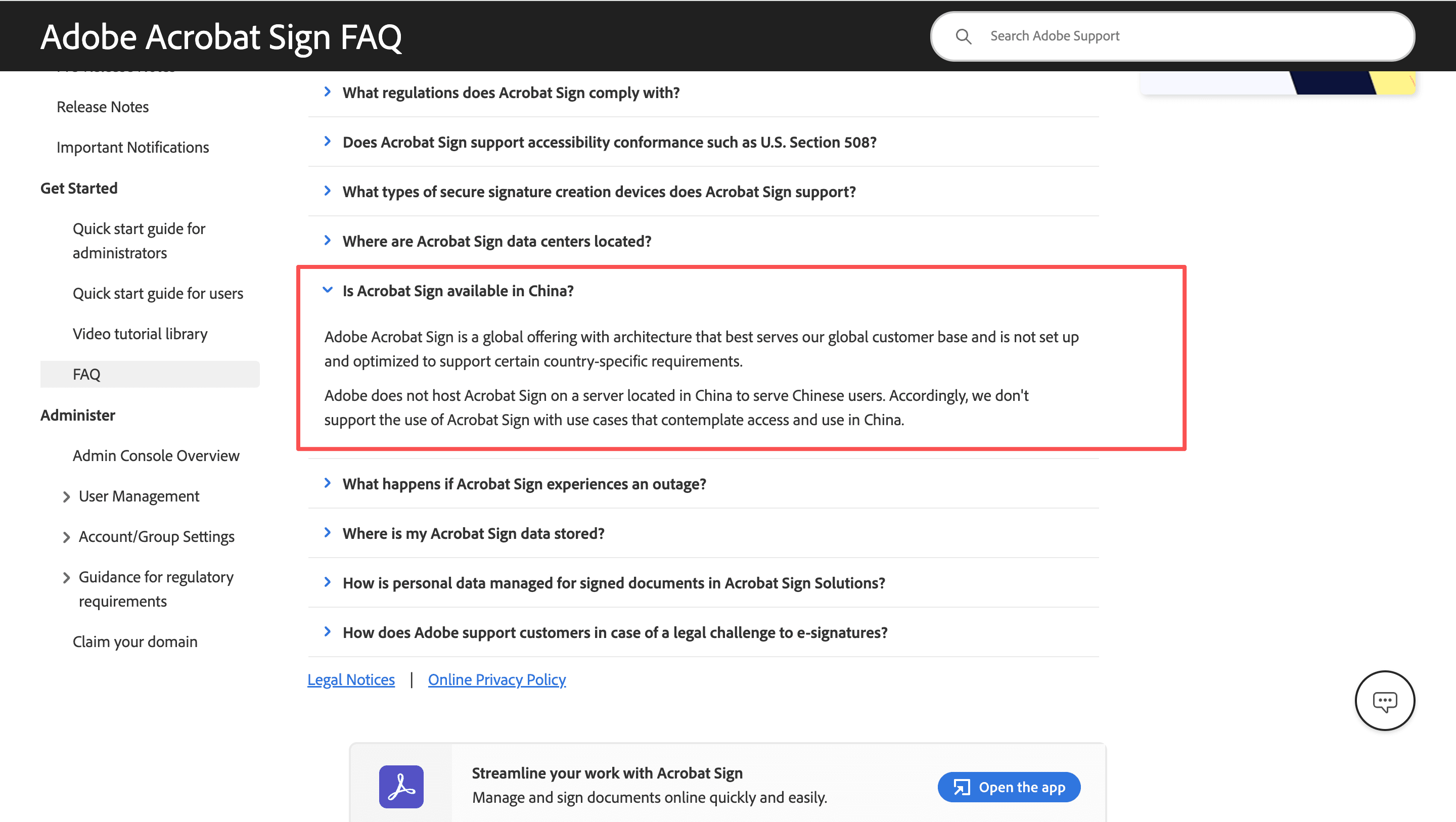 Source: Adobe Acrobat Sign FAQ
But the issue goes far beyond a firewall. Adobe’s decision to leave effectively covers the entire Chinese market, including Hong Kong. While Mainland IPs are technically blocked, Hong Kong businesses are stuck in a difficult position: they are paying premium rates for a tool that lacks essential local support (such as "iAM Smart" integration) and is now completely cut off from their supply chain in the Mainland.
Right now, teams across the region are forced into dangerous workarounds. Mainland branches are using VPNs to access the dashboard, while Hong Kong headquarters struggle to send valid contracts to partners across the border.
Let’s be clear: masking your IP or using non-compliant tools to sign a contract is a major compliance risk. Under strict data laws, a contract signed through a "backdoor" channel is a liability, not an asset.
This reality changes how we must evaluate Adobe Sign pricing and plans today. You aren't just calculating the cost of a digital signature. You are auditing the cost of a broken, non-compliant workflow in a market that Adobe has decided to leave behind.
Adobe Sign Pricing and Plans (2026 Review)
To accurately evaluate Adobe Sign pricing, one must first understand Adobe’s product strategy. Adobe treats electronic signatures not as a standalone utility, but as a feature within the Acrobat document ecosystem.
- For creative professionals: This bundle offers value.
- For business signing: This structure often means paying for features you never use.
Here is a professional breakdown of the four main plans available in 2026: (Price verified on Adobe's official pricing page as of Jan 2026)
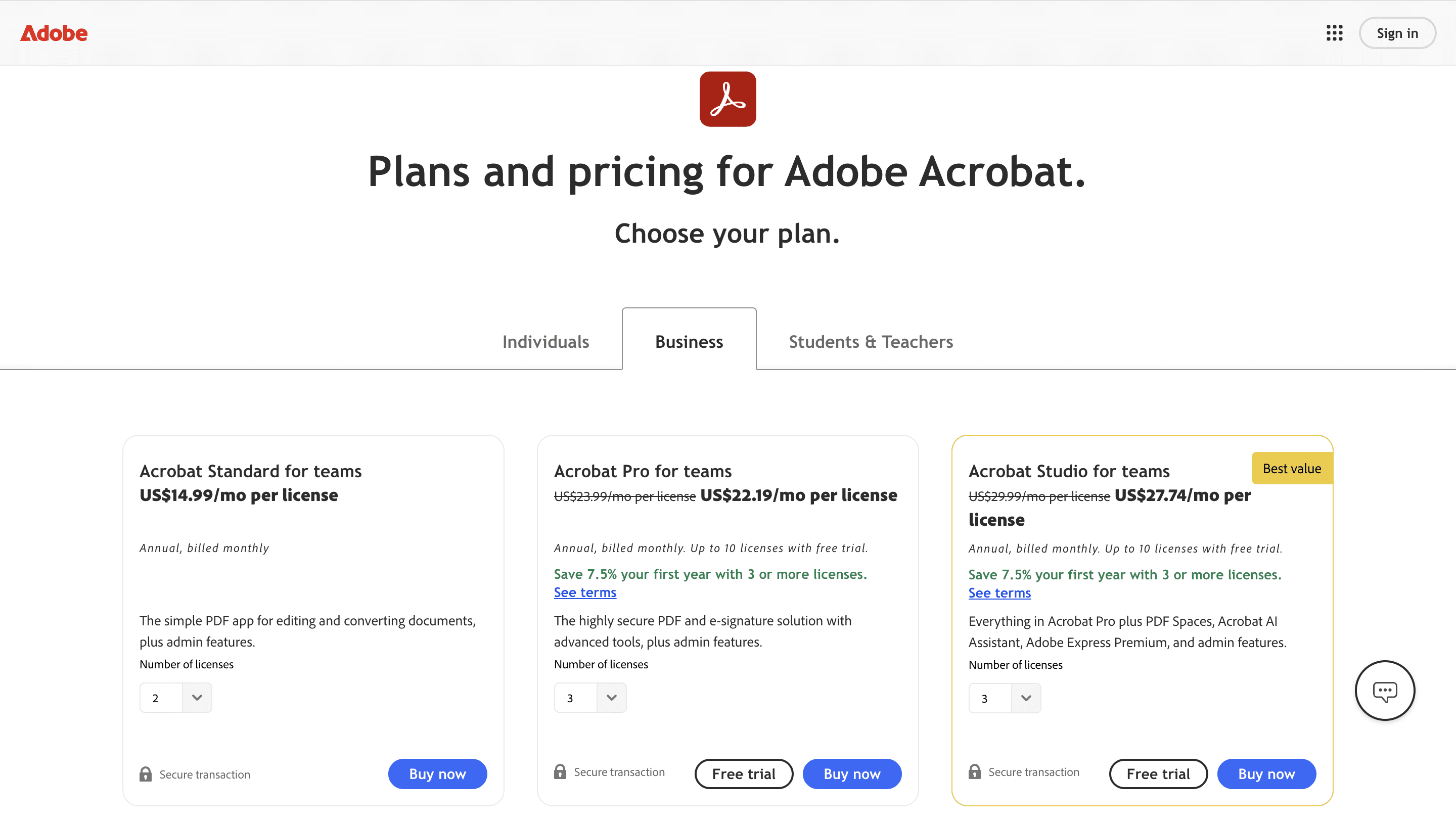 Source: Adobe Official Business Pricing Page
1. Adobe Acrobat Standard (Individuals)
- Target Audience: Solo freelancers or Windows-based administrative staff.
- Estimated Cost: ~ $12.99/mo (per license, billed annually).
- Core Features: Basic PDF creation, editing, and e-signing.
- Critical Limitations:
- Platform Restriction: This tier is strictly Windows-only. In a modern office where macOS is prevalent, this forces an upsell to the "Pro" tier.
- Management Gap: Lacks a centralized Admin Console. Documents are tied to a specific person's email. If an employee leaves, retrieving past contracts is legally difficult.
2. Adobe Acrobat Pro (Individuals)
- Target Audience: Creative professionals, marketing teams, and power users requiring advanced document processing.
- Estimated Cost: ~ $19.99/mo (per license, billed annually).
- Core Features: Full cross-platform support (Mac/PC), redaction tools, ISO-standard PDF conversion, and OCR.
- Value Analysis: While powerful, the cost is hard to justify for Sales or HR roles that just need to send contracts. For a 10-person sales team, this premium adds up to nearly $840 in annual surplus spend for unused features.
3. Acrobat Standard/Pro for Teams
Target Audience: SMBs and departments requiring license management.
Estimated Cost:
Standard: ~$14.99/user/mo.
Pro: ~$23.99/user/mo.
Feature Analysis: Adds the Admin Console for license reassignment and tech support.
The "Fair Use" Constraint: While marketed as "unlimited," Adobe’s terms include a "Fair Use" policy, typically capped at 150 transactions per user, per year.
Impact: A recruiter sending just 15 contracts a month will breach this limit. Once exceeded, Adobe may slow down service or force an upgrade to Enterprise.
4. Adobe Acrobat Sign Enterprise (Solutions)
- Target Audience: Large corporations needing SSO (Single Sign-On) and API integrations.
- Pricing Model: Custom Quote (Volume or Seat-based). Typically involves a high minimum annual contract value (ACV).
- Service Analysis (2026 Context):
- Implementation: Offers robust APIs but often requires certified consultants.
- Regional Fit: Operates on a "Global Instance" architecture.
- Major Problems for Greater China:
- Data Residency: Does not store data locally in Mainland China (PIPL compliance risk).
- Local Authentication: Lacks built-in support for local IDs like Hong Kong’s iAM Smart or Singapore’s Singpass, requiring expensive custom development.
How Nota Sign Stands Out: The APAC Standard
While Adobe’s service adjustments have created an operational void, Nota Sign has built a solution specifically for the needs of Asian markets.
It is designed to bridge the gap between Global Headquarters and Asian branches, understanding the difference between a standard e-signature in New York and a government-verified digital identity in Jakarta.
Here is why regional leaders like Merck, Stryker, Chery, and 51Talk trust Nota Sign:
1. The "Compliance Shield": From China to the Belt and Road
Nota Sign offers robust audit trails and legally binding signatures.
- Mainland China (PIPL Safe): Offers local data residency options. Contracts signed in the Mainland remain compliant without requiring VPN workarounds.
- Southeast Asia (The "Belt and Road" Complexity):
- Indonesia: Handles Law 11/2008 (ITE Law) requirements for certified provider (PSrE) signatures.
- Singapore: Seamless integration with Singpass for gold-standard secure signing.
- Hong Kong: Native integration with iAM Smart for government-verified digital identity signing.
2. A Pricing Model Built for Scale, Not "Seat Count"
Adobe’s rigid per-user licensing gets expensive as you grow. Nota Sign’s model scales with you.
- The Team Standard ($1,998/Year): A flat-rate Standard Edition for teams. Includes essential features like Bulk Sending without forcing migration to a custom "Enterprise" plan.
- Consumption-Based Flexibility: You pay for the security event, not shelf-ware. Advanced features like Facial Recognition (eKYC) and SMS OTP are available as usage packs.
3. Industry-Specific Continuity (Life Sciences & Manufacturing)
- Life Sciences (Merck & Stryker): Supports FDA 21 CFR Part 11 compliance for clinical trials and pharmaceutical documents—features competitors often hide behind expensive tiers.
- Global Manufacturing (Chery & Goertek): Enables seamless cross-border signing that respects strict data laws of manufacturing hubs.
Comparison: The Verdict
The "safe" choice used to be buying the biggest brand name. Today, the smart choice is buying the tool that actually functions in your specific regulatory environment.
In 2026, the divide is clear: Adobe Sign remains a powerful tool for Western creative teams, while Nota Sign has established itself as the operational backbone for cross-border business in Asia.
Switch to Nota Sign if:
- You are an Overseas Enterprise signing with Chinese Partners: If you send contracts to Mainland China, you cannot risk an "Access Denied" screen. Nota Sign ensures documents open and sign immediately—without needing a VPN.
- You Have Regional Operations in Greater China or SE Asia: You need a tool that bridges Global HQ and local execution without triggering data residency violations (PIPL).
- You Need "High Trust" Local Electronic Signatures: You need native integration with Hong Kong’s iAM Smart, Singapore’s Singpass, or Indonesia’s PSrE signatures.
- You Prioritize ROI (No "Bloatware" Tax): You want Bulk Sending and unlimited users without a six-figure Enterprise contract.
Stick with Adobe Acrobat Sign if:
- You Operate Exclusively in the US or EU: Adobe’s global standards are enough if you have no business in Asia.
- You Are a "Creative Cloud" Power User: Your team needs to perform heavy, complex edits to PDF files before sending them.
- Budget is Secondary to Ecosystem: You prefer having one single vendor and don't mind paying a premium.
Final Thoughts
In 2026, the smart choice isn't the biggest brand—it's the specialist that actually works in your region. Nota Sign isn't just a cheaper alternative. It is the necessary evolution for cross-border commerce.
It bridges the gap between Western standards and Asian digital rules, ensuring that your contracts don't just get sent, but actually get signed, sealed, and legally recognized.
Stop letting your budget die by a thousand paper cuts—or in this case, a thousand unused PDF editing features. Switch to the tool built for the reality of doing business in Asia today.



